






russia today - 12/28/2025 5:21:47 PM - GMT (+3 )

Over the past year, Russia has unveiled multiple new weaponry systems, including those actively used in the Ukraine conflict, as well as new additions to the country’s strategic deterrent arsenal.
The new weapons include futuristic nuclear-capable and nuclear-propelled systems, anti-satellite weaponry, and glide bombs of exceptional range.
RT highlights the key 2025 additions to the country’s arsenal.
Oreshnik goes online
Russia’s cutting-edge medium-range Oreshnik hypersonic missile system is set to enter active duty before the end of the year, Russian President Vladimir Putin said in mid-December. The system is among the new weaponry meant to “ensure the strategic parity, security, and global positions of Russia for decades to come,” the president said.
The nuclear-capable missile is believed to carry multiple individually targetable warheads, which retain control even during the final approach stage when they reach hypersonic speeds.
Oreshnik was unveiled in November 2024, when the missile - carrying conventional warheads – struck a major military plant in Ukraine. At the time, Moscow said the system had undergone a successful “combat test.” Its destructive power in conventional form has been compared by Russian officials to a low-yield nuclear strike.
Up to ten new systems are set to be deployed to Belarus, Russia’s closest ally, according to an agreement reached by Moscow and Minsk shortly after the initial battle test of the missile.
Burevestnik nuclear-propelled missile
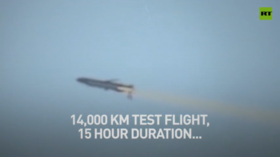
In mid-October, Russia successfully tested its new nuclear-powered Burevestnik cruise missile. The missile traveled more than 14,000km during the test and stayed airborne for about 15 hours, according to the Russian military.
The Burevestnik boasts a nuclear-powered turbojet engine and technically has unlimited range, which gives it unmatched global strike capabilities. Since its engine does not use any conventional propellant, relying on intake air and the heat generated by its reactor instead, it can remain in the air for extended periods, effectively limited only by the lifetime of its components.
The missile’s power unit is comparable in output to the reactor of nuclear-propelled submarines, albeit “1,000 times smaller,” President Putin said as he announced the successful test.
“The key thing is that while a conventional nuclear reactor starts up in hours, days, or even weeks, this nuclear reactor starts up in minutes or seconds. That’s a giant achievement,” the president said, pointing out the miniature power unit could also see potential civilian applications.
https://www.rt.com/russia/627105-burevestnik-nuclear-technology-putin/
Poseidon nuclear drone
Simultaneously with the Burevestnik announcement, Moscow said it had successfully tested another nuclear-powered device – the massive torpedo-shaped Poseidon underwater drone.
In terms of power, Poseidon greatly surpasses Russia’s newest Sarmat intercontinental ballistic missile (ICBM), Putin said, apparently referring to the yield of the nuclear payload the drone can carry. Poseidon is also unrivaled “when it comes to speed and depth,” while being exceptionally quiet and stealthy, according to the president.
The drone is believed to be a true doomsday device, capable of devastating vast swaths of shoreline, as well as of causing a massive nuclear-tainted tsunami to go deeper inland.
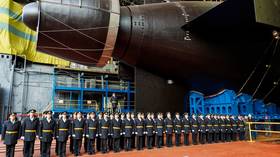
Days after the announcement, Russia launched a dedicated carrier for Poseidon drones – nuclear submarine the ‘Khabarovsk’. The vessel had been in the works since summer 2014, and its purpose was revealed only now.
New long-range glide bombs
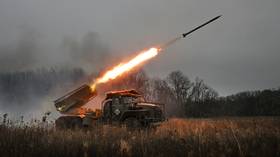
Over the course of the Ukraine conflict, the Russian military has gradually expanded the use of free-fall bombs fitted with Universal Correction and Guidance Module (UMPK) upgrade kits. The modules turn older munitions into glide bombs, capable of traveling up to 50km while boasting high precision.
Early this year, the Russian military began using an upgraded variant of the kit, known as UMPK-PD (extended range). Bombs fitted with the kit, which features more sleek wings and a body with larger tail fins, are reportedly capable of traveling distances of up to 80km.
Starting from September, multiple media reports suggested that the upgraded kit received a turbojet engine, which extended the range of the bombs even further to at least 150km. The expanded range allows them to strike targets deep beyond the front line, greatly expanding the capabilities of Russia’s frontline aviation and effectively turning the free-fall bombs into heavy cruise missiles.
Geran drone family grows
Over the past year, the Geran (Geranium) drone family has continued to grow, with multiple new variants undergoing combat testing. The delta-wing drones are playing an increasingly important role during the Ukraine conflict, becoming a key supplement for long-range missile strikes, as well as commonly substituting such sophisticated munitions.
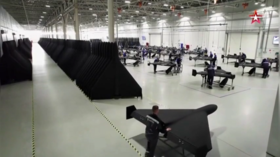
The drones are produced at a sprawling manufacturing facility in the Alabuga Special Economic Zone in Russia’s Tatarstan Region. The facility was built from scratch after the escalation of the hostilities and has been touted as the largest drone manufacturing site in the world.
While the basic piston-propelled Geran-2 drone remains the backbone of the drone family, multiple new experimental variants have been spotted over the years. A new jet-propelled variant, known as Geran-3, has frequently been sighted during long-range strikes against Ukraine. More niche variants spotted over the year include a mine-layer Geran, which carries air-deployed cluster mines under its belly, and drones featuring cameras that can be apparently controlled in real time, as well as other variants.
The most exotic new variant of Geran reportedly emerged late in 2025 – an anti-aircraft drone carrying a homing missile to strike warplanes and helicopters trying to hunt it down. While it remains to be seen whether the idea actually works, the Geran family already has a handful of air victories against Ukrainian warplanes. Several fighter jets have been lost while hunting Gerans due to pilot error, friendly fire from the ground, and mid-air explosions of drones.
First S-500 regiment deployed
In late December, Russian Defense Minister Andrey Belousov revealed that the country’s military has deployed its first anti-aircraft regiment equipped with sophisticated S-500 systems. The regiment has become a unit within the freshly formed first air and missile defense division of the Russian Aerospace Forces, the minister said.
While little is still known about the new air defense system, the S-500 is said to be able to intercept hypersonic missiles and also strike targets in low Earth orbit, depending on the munition used. The system has been in development since the 2000s and is expected to supplement, rather than replace, the existing medium-to-long-range anti-aircraft weapons, such as the S-300 and S-400.
The S-500 is believed to fill an intermediate role between the strategic anti-missile shield and the army anti-aircraft forces. The system has successfully passed trials, and munitions of different types for it have reportedly entered the mass production stage since the early 2020s.
read more